

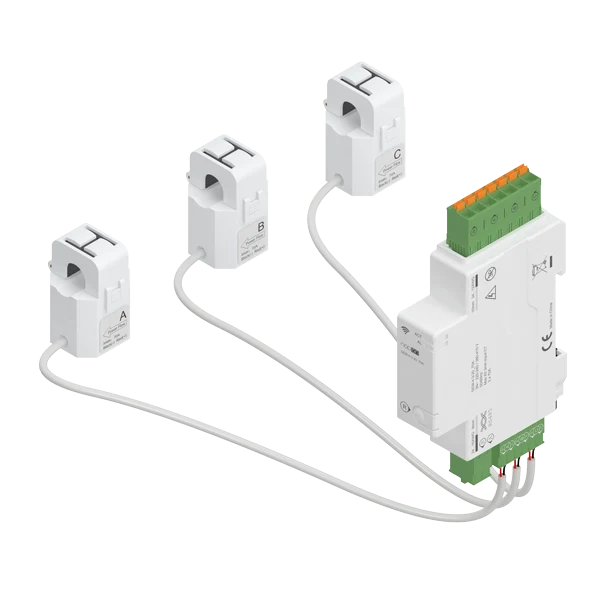
Three-phase installation, or single-phase with three independent circuits: the SEM-4-3-20 measures each phase accurately with its split-core clamps and sends the data in real time to your Zigbee gateway or your BMS.
Knowing what each phase consumes
In a typical electrical panel, you know the overall consumption from the utility meter, and rarely more than that. Once a heat pump, an EV charger or solar panels come into play, that overall view is no longer enough: you cannot tell which phase is the most loaded, nor what is actually being fed back to the grid at a given moment.
NodOn's 3CT energy meter sits in the panel and reads each phase separately. Its clamps open to go around the conductors, so there is no need to disconnect them.
The SEM-4-3-20 at a glance
The module takes up a single DIN slot (18 mm) and comes with three current clamps. For each phase, it reads consumption or production with 1% accuracy, then passes the values on to a Zigbee gateway or a BMS.
|
📊
Three phases measured
Current, voltage, power and cumulative energy are read phase by phase, from 50 mA up to the maximum rating of the clamps (70 A or 120 A depending on the reference)
|
🔄
Consumption and injection
The direction of flow is taken into account, so you can also follow the output of a solar installation
|
|
🎯
Class 1.0
±1% accuracy according to IEC 61557-12, for values you can rely on in your automations
|
📐
Split-core clamps
They close around conductors that are already in place, which suits both new builds and renovations
|
Wiring in the panel
The module is fixed on a DIN rail. It needs one voltage tap per phase (plus neutral) and a current sensor around each conductor to be measured. The user guide provides for two setups:
|
Diagram A
Three-phase network 3P+N
One clamp per phase (A, B and C), with the voltage inputs LA, LB, LC and N connected downstream of the protection device. The meter then provides the values for each phase of the installation.
|
Diagram B
Three single-phase circuits
Each clamp is placed on a separate single-phase circuit, for example a water heater or an EV charger, with a single voltage reference (L and N). One module therefore monitors three feeders.
|
Getting it running
|
1
|
Wiring
With the power off, clip the module onto the DIN rail and connect the voltage inputs LA, LB, LC and N downstream of the protection device. Then close each clamp around the matching conductor, arrow pointing in the direction of the current, pairing VA with IA, VB with IB and VC with IC. When power is restored, the LED should not signal any alarm.
|
|
2
|
Zigbee pairing
In your gateway interface (Home Assistant, Jeedom, Zigbee2MQTT or another), start adding a Zigbee device. On the meter, hold the RESET button down until the green LED flashes twice per second. Once pairing is complete, it stays on continuously.
|
|
3
|
Using the data
For each phase, you get power, cumulative energy, current and voltage. These values can feed a dashboard, alerts or automations. The SEM-4-3-20 also has a Modbus interface.
|
Example uses
| ☀️ Compare the energy drawn from the grid with the surplus fed in by a photovoltaic installation | 🏢 Split consumption between several zones of a shared building, such as a coworking space or an apartment block |
| 🚗 Adjust the charging power of an electric vehicle to the available solar surplus | 🔔 Trigger load shedding or an alert in case of overconsumption |
The reference
The SEM-4-3-20 installs on its own in the panel, single-phase or three-phase, and talks to a Zigbee gateway or a BMS. It is offered in 70 A and 120 A.
|
Energy meter
SEM-4-3-20_70A / SEM-4-3-20_120A
3CT Zigbee Energy Meter
View the product →
|
Key features
Measurement: 50 mA to 70 A or 120 A per phase
Accuracy: ±1% (class 1.0)
Power supply: 220-240 VAC / 380-415 VAC, 50/60 Hz
Protocol: Zigbee 3.0, OTA updates
Dimensions: 113.7 mm (H) x 18 mm (W) x 65.9 mm (D)
|
Resources
| 📄 Product page |
| 📖 User guide [FR / EN] |
| 📊 Datasheet [EN] |
| 🔗 SEM-4-3-20 on Zigbee2MQTT [EN] |


Leave a comment
This site is protected by hCaptcha and the hCaptcha Privacy Policy and Terms of Service apply.