
The first article in the series laid the foundations of an open-source residential EMS with Home Assistant and NodOn Zigbee products. The second article showed how to precisely measure energy flows with the SEM-4-1-00.
This third article takes the next step: once the data is available, how can it be used to optimize photovoltaic self-consumption? Pascal Stephany shares his approach.
The full series:
- Building a residential EMS with Home Assistant and NodOn Zigbee products
- Measuring energy flows with the SEM-4-1-00: the first step towards a more energy-efficient home
- Optimizing photovoltaic self-consumption with Home Assistant and NodOn Zigbee solutions
- Controlling a photovoltaic water heater with the SIN-4-1-21: turning solar surplus into hot water
Optimizing photovoltaic self-consumption with Home Assistant and NodOn Zigbee solutions
Article 3/4 of the series "The residential EMS by Pascal Stephany"
With rising energy costs, having photovoltaic panels is no longer enough. To maximize the savings achieved, it is essential to measure, understand and intelligently control the energy flows of one's home.
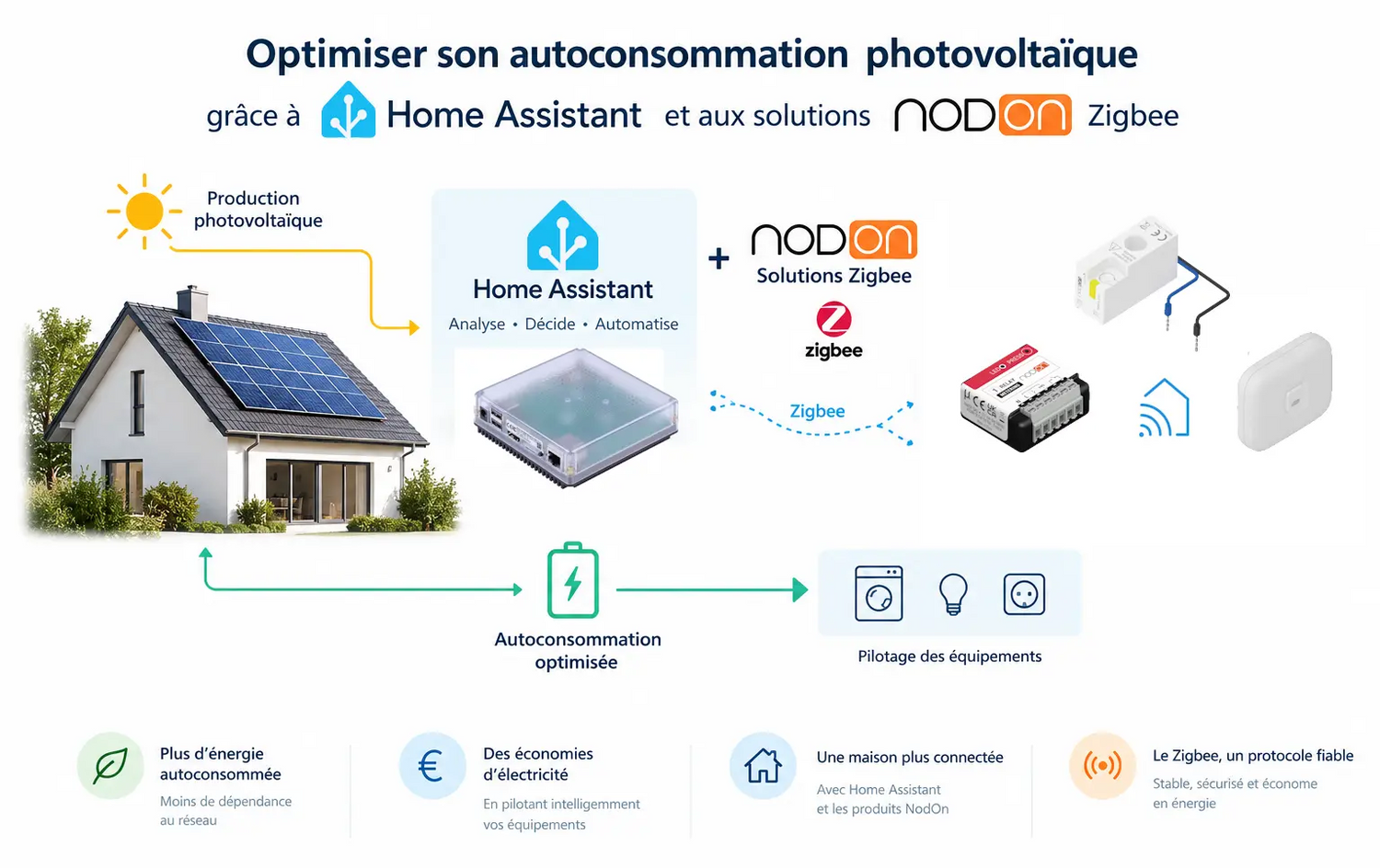
This is precisely the approach I have implemented around Home Assistant, relying on several NodOn Zigbee solutions to monitor and automate my entire installation.
Measuring every energy flow
Every optimization strategy starts with reliable measurement.
The SEM-4-1-00 Smart Zigbee Energy Meter enables precise monitoring of instantaneous power and energy consumed or injected across different electrical circuits.

Several meters distributed across the electrical panel allow me to monitor, among other things:
- household consumption;
- photovoltaic production;
- exchanges with the electricity grid;
- the main high-consumption appliances.
Thanks to this global overview, Home Assistant has all the information it needs to make the right decisions in real time.
Intelligently controlling appliances
Measurement only has value if it enables action.
For appliance control, I mainly use the SIN-4-1-21 Zigbee Multifunction Relay Switch with Metering or SIN-4-1-20, mounted in DRB-1-3-00 DIN Rail Boxes.
In addition to controlling an appliance, this module also reports its instantaneous power and cumulative energy, making it an excellent candidate for applications such as:
- water heater control;
- electrical appliance switching;
- controllable load management;
- photovoltaic self-consumption optimization.
In my installation, this module helps control the water heater to make the most of solar production surpluses.
« My Cumulus becomes a virtual battery »

Prioritizing solar surplus uses
The goal is simple: limit energy injection to the grid as much as possible.
When photovoltaic production exceeds household consumption, Home Assistant automatically adapts usage according to different priorities:
- domestic hot water production;
- domestic battery charging;
- powering the various household appliances.

This automation logic significantly increases the self-consumption rate while reducing grid imports.
Integrating air conditioning into the energy strategy
Energy optimization is not limited to heating or photovoltaics.
The IRB-4-1-00 Zigbee AC Infrared Controller makes it very easy to integrate an infrared-compatible air conditioner or air-to-air heat pump into Home Assistant.
By combining this controller with energy data, it becomes possible to imagine scenarios such as:
- starting the air conditioning when the photovoltaic surplus is sufficient;
- automatically adjusting the temperature according to solar production;
- optimizing comfort while limiting grid consumption.
Home Assistant, the true orchestrator
Thanks to the various NodOn Zigbee products, Home Assistant centralizes all the energy information of the installation.
Data from meters, control modules, batteries and appliances are used to create automations adapted to consumption habits.
This approach not only allows precise visualization of energy flows, but above all enables automatic action to use every kilowatt-hour at the best possible moment.
Conclusion
Energy efficiency relies above all on a thorough knowledge of one's installation.
Combined with Home Assistant, NodOn Zigbee products offer an open and interoperable solution for measuring, controlling and optimizing consumption without depending on a closed ecosystem.
Whether monitoring photovoltaic production, controlling a water heater, managing batteries or integrating air conditioning, this approach demonstrates that a smart installation can significantly improve the self-consumption rate while providing optimal comfort.

Key takeaways
✔ Photovoltaic self-consumption is optimized by measuring, controlling and automating energy flows.
✔ The SEM-4-1-00 provides real-time monitoring of each circuit: production, consumption, grid.
✔ The SIN-4-1-21 enables simultaneous control and measurement, ideal for using solar surplus on the water heater.
✔ Home Assistant automatically prioritizes surplus uses: hot water, batteries, appliances.
✔ The IRB-4-1-00 integrates air conditioning into the overall energy strategy.
✔ The whole solution relies on an open, interoperable and scalable Zigbee ecosystem.
Products used
- SEM-4-1-00 – Smart Zigbee Energy Meter
- SIN-4-1-21 – Zigbee Multifunction Relay Switch with Metering · Independent review ↗
- DRB-1-3-00 – DIN Rail Box
- IRB-4-1-00 – Zigbee AC Infrared Controller · Independent review ↗
 eHome Labs
Passionate about home automation for over 20 years, I continuously evolve my installation in line with my experiments and new technologies. Each automation is tested in real conditions before being adopted in daily life, turning this installation into a true full-scale laboratory.
This approach allows me to continuously refine the home's energy strategy and fully exploit the possibilities offered by Home Assistant and NodOn Zigbee solutions.


Leave a comment
This site is protected by hCaptcha and the hCaptcha Privacy Policy and Terms of Service apply.