
The first article in the series laid the groundwork for an open-source residential EMS with Home Assistant and NodOn Zigbee products.
This second article gets practical: before optimizing, you have to measure. How can you accurately monitor a home's energy flows? What role does the SEM-4-1-00 play in this process?
Pascal Stephany shares his experience.
The complete series:
- Building a residential EMS with Home Assistant and NodOn Zigbee products
- Measuring energy flows with the SEM-4-1-00: the first step towards a more energy-efficient home
- Optimizing your photovoltaic self-consumption with Home Assistant and NodOn Zigbee solutions
- Controlling a photovoltaic water heater with the SIN-4-1-21: transforming solar surplus into hot water
Measuring energy flows with the SEM-4-1-00: the first step towards a more energy-efficient home
"Understanding your consumption is the first step towards real energy optimization."
Article 2/4 of the "Residential EMS by Pascal Stephany" series

Installing photovoltaic panels, a battery, or a charging station is increasingly common today. However, many individuals quickly realize that they are producing energy... without truly knowing where it is being consumed.
How much is my home consuming right now?
What is my photovoltaic production?
Am I injecting energy into the grid or importing it?
Which equipment consumes the most energy?
All these questions have one thing in common: they require reliable and precise measurement.
🏡 Reference Installation
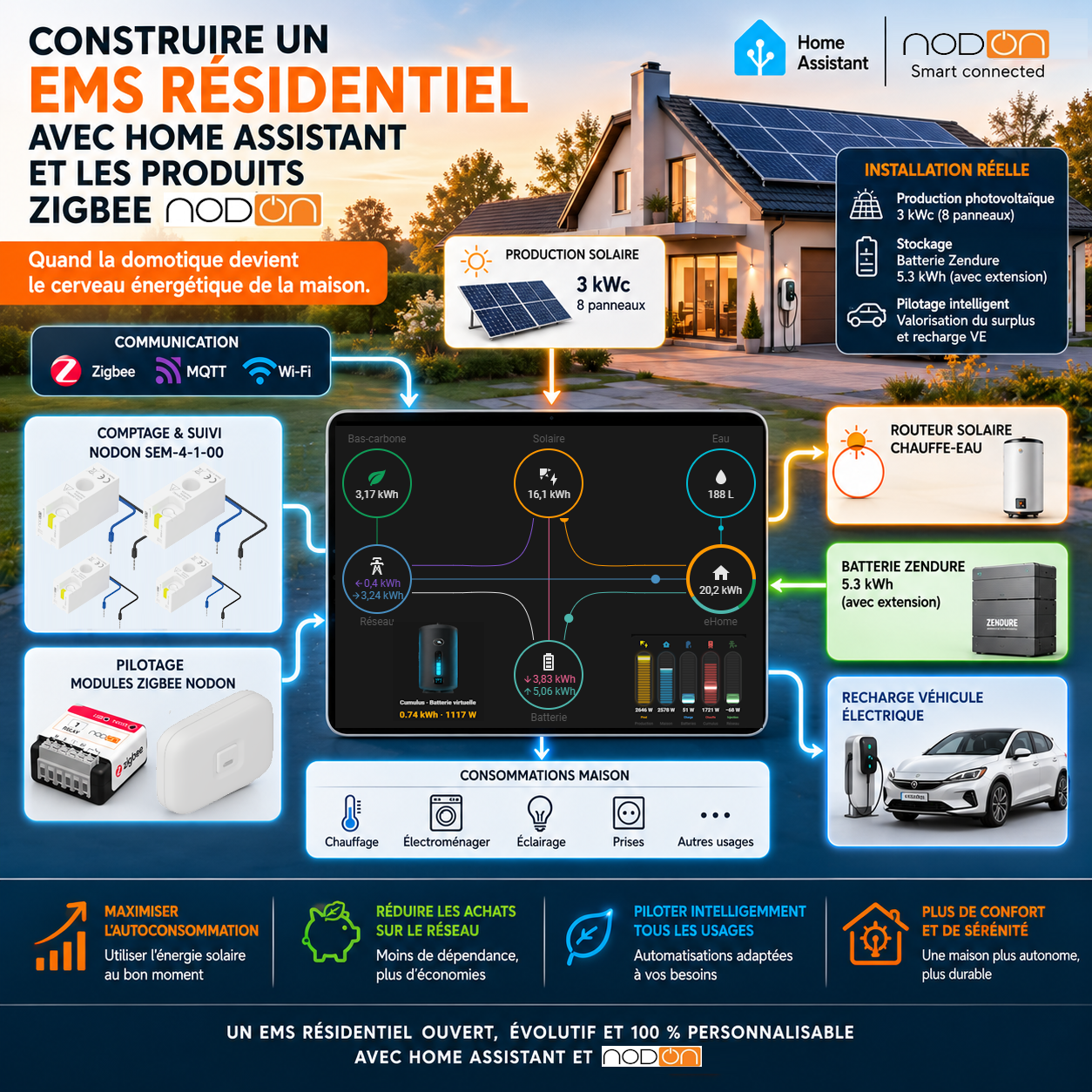
All demonstrations presented in this series are based on a real installation, used daily and fully controlled by Home Assistant.
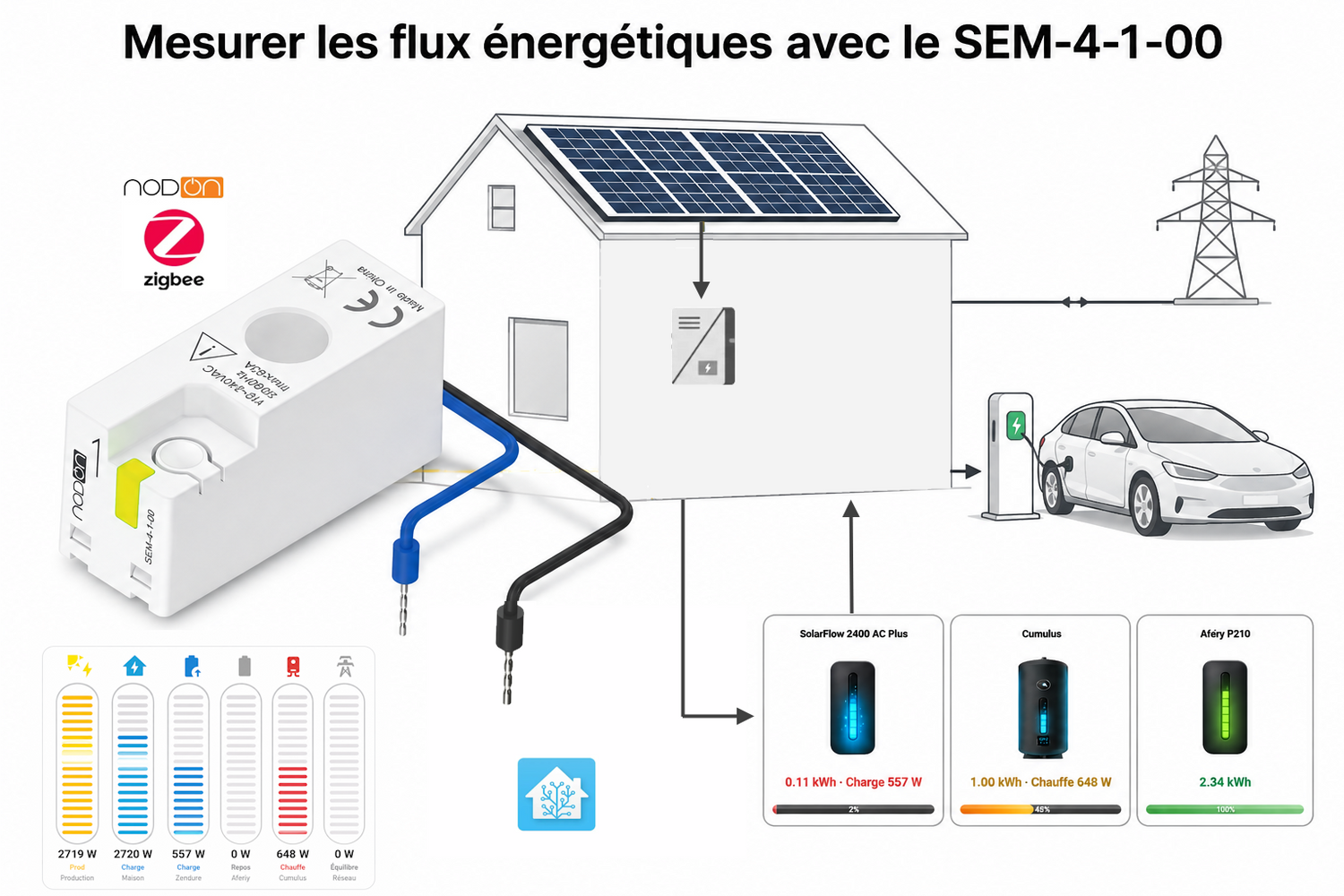
This installation relies on a 3 kWp photovoltaic production combined with a home automation system communicating via Zigbee, MQTT, and Wi-Fi. Energy management and monitoring are ensured by NodOn SEM-4-1-00 meters, various NodOn Zigbee modules for equipment control, among others.
To maximize self-consumption, surplus solar energy is also stored in a Zendure battery or utilized by a dedicated solar routing for the water heater, while electric vehicle charging is intelligently controlled by Home Assistant.
The objective of this series is to show, based on this concrete installation, how to automate and optimize the production, storage, and consumption of energy on a daily basis.
Measure before automating
Even before creating automations in Home Assistant, it is essential to have reliable data.
This is precisely the role of the SEM-4-1-00, NodOn®'s Zigbee energy meter.
Designed to be integrated directly into an electrical panel, it allows real-time measurement of instantaneous power as well as consumed energy using a non-intrusive current clamp.

This ease of installation makes it simple to add new measurement points without modifying existing wiring.
"What cannot be measured cannot be optimized."
A complete overview of the installation
In my installation, several SEM-4-1-00 units are distributed across different circuits to gain a global view of energy flows.
They notably allow monitoring of:
- the total consumption of the house (Linky);
- photovoltaic production;
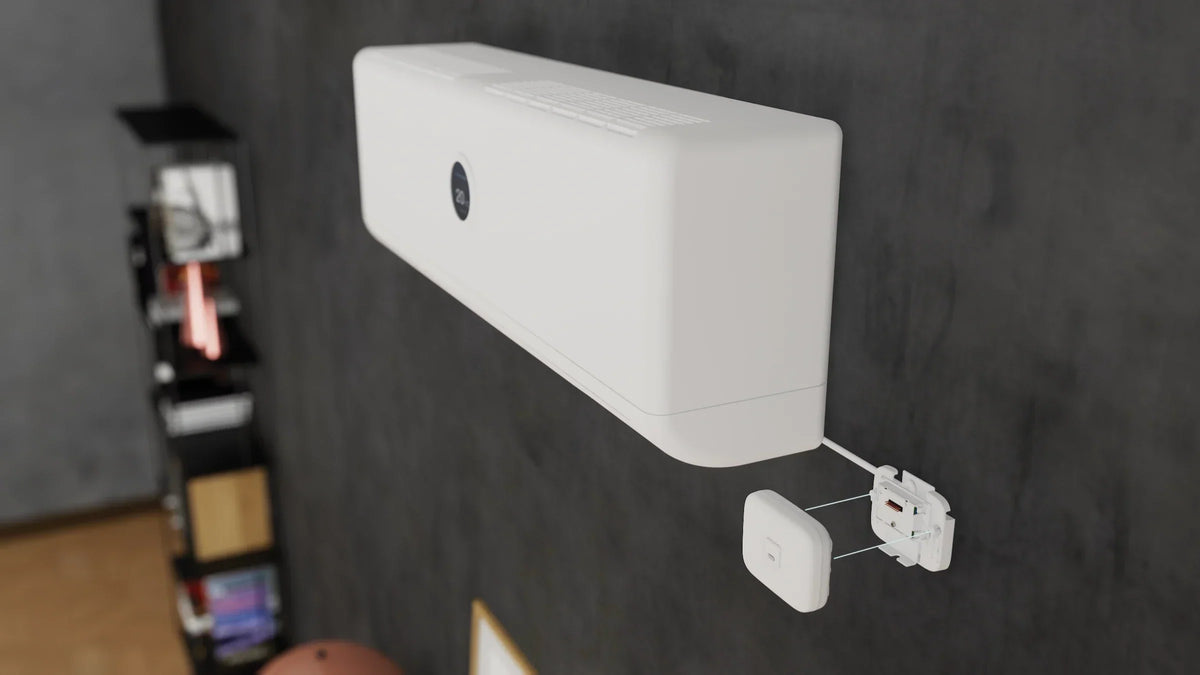
- air conditioning units (Air-to-Air heat pumps);
- the water heater;
- the Lab;
- the electric vehicle charging station.
Each meter transmits its information via Zigbee to Home Assistant, where all data is centralized and displayed as shown below, for example.
Power Flow Card
Understanding flows in real-time
One of Home Assistant's main advantages is its ability to aggregate data from multiple devices.
By combining measurements from different SEM-4-1-00 units, it becomes possible to instantly know:
- the actual power consumed;
- the available photovoltaic production;
- the power injected into the grid;
- the power imported from the grid;
- the consumption of each monitored circuit.
This information forms the basis for all future optimizations.

An ideal basis for automations
Once measurements are available, Home Assistant can make intelligent decisions.
For example:
- automatically starting a water heater when a photovoltaic surplus is detected;
- charging a battery when production becomes excessive;
- deferring certain energy-intensive equipment;
- sending a notification when abnormal consumption is detected.

The SEM-4-1-00 does not directly control equipment, but it provides the essential information that will allow automations to make the right decisions.
An open solution
One of the main strengths of the SEM-4-1-00 lies in its Zigbee functionality.
Compatible with Home Assistant via Zigbee2MQTT or ZHA, it integrates naturally into an open home automation environment.

The data can then be used in:
- the Home Assistant Energy dashboard;
- custom dashboards;
- automations;
- consumption statistics;
- energy optimization scenarios.

The user remains completely free to design their own energy management system.
My experience feedback
After several months of use, I consider energy meters to be the true "eyes" of my installation.
They allow me not only to precisely monitor consumption, but above all to power a true energy management system built around Home Assistant.
Today, the decisions made by my installation—water heater control, battery management, equipment monitoring, or self-consumption optimization—all rely on the measurements reported by these meters.
Ultimately, before even trying to save energy, you must first learn to understand it.
Key takeaways
✔ Precisely measuring energy flows is the first step towards a more energy-efficient home.
✔ The SEM-4-1-00 measures the instantaneous power and consumed energy of each circuit in real-time.
✔ Its non-intrusive installation allows for easy addition of new measurement points.
✔ Data reported to Home Assistant forms the basis for all energy automations.
✔ The Zigbee protocol ensures native integration with an open and scalable home automation ecosystem.
Products used
 eHome Labs
Passionate about home automation for over 20 years, I evolve my installation with my experiments and new technologies. Each automation is tested in real conditions before being adopted daily, making this installation a true full-scale laboratory.
This approach allows me to continuously refine the house's energy strategy and fully exploit the possibilities offered by Home Assistant and NodOn Zigbee solutions.

Leave a comment
This site is protected by hCaptcha and the hCaptcha Privacy Policy and Terms of Service apply.