
At NodOn, we are fortunate to have a team of enthusiasts who don't just design products—they live them every day.
Pascal Stephany, NodOn Product Manager, has built a complete home automation and energy system at his home, controlled by Home Assistant and NodOn Zigbee solutions. For several months, he has been experimenting with it, improving it, and drawing concrete lessons that he is ready to share.
This is the subject of this new series of articles, to be published over the coming weeks:
- Building a Residential EMS with Home Assistant and NodOn Zigbee products
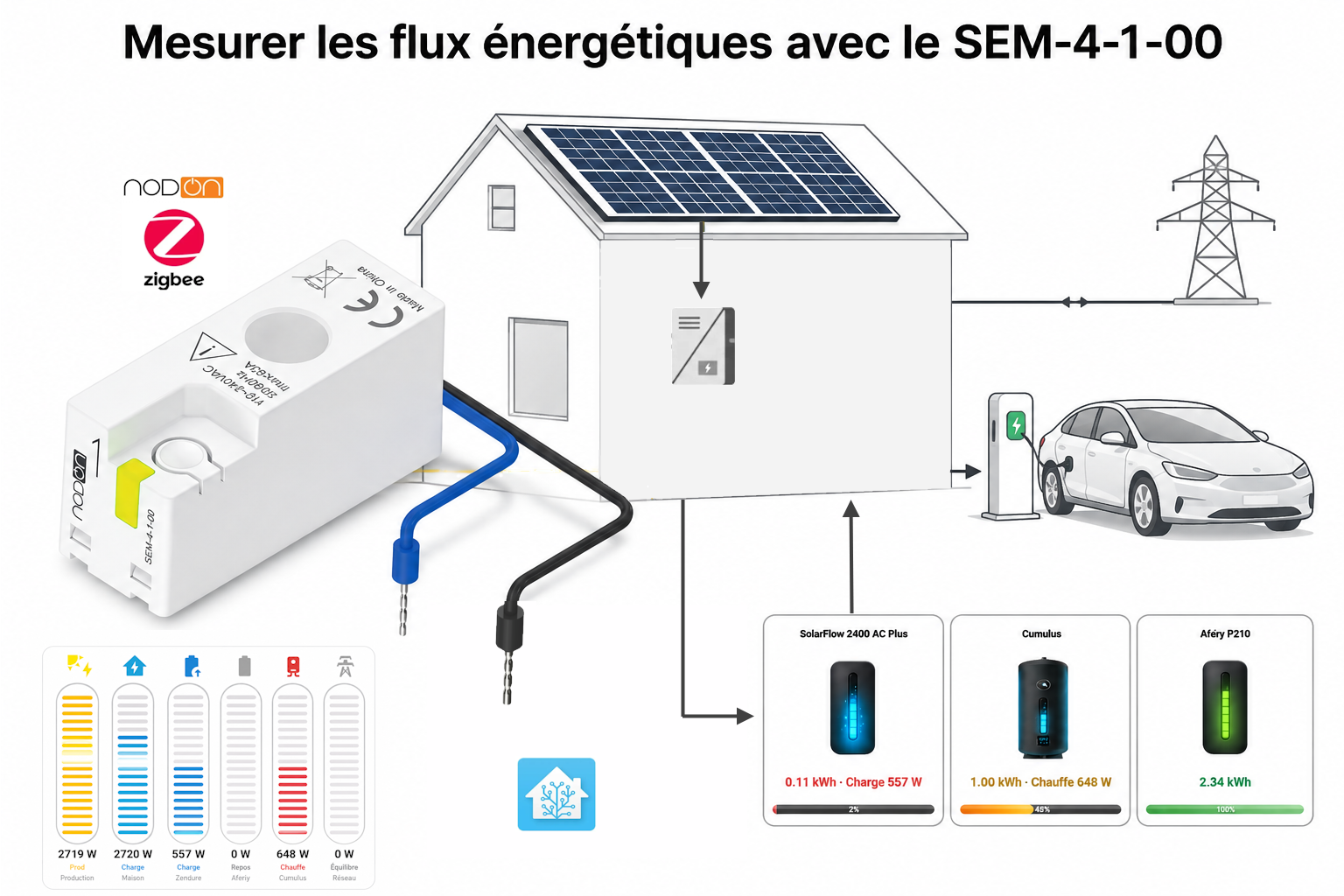
- Measuring energy flows with the SEM-4-1-00: The first step towards a smarter home
- Optimizing photovoltaic self-consumption with Home Assistant and NodOn Zigbee solutions
- Controlling a photovoltaic water heater with the SIN-4-1-21: Turning solar surplus into hot water
🏡 Reference Installation
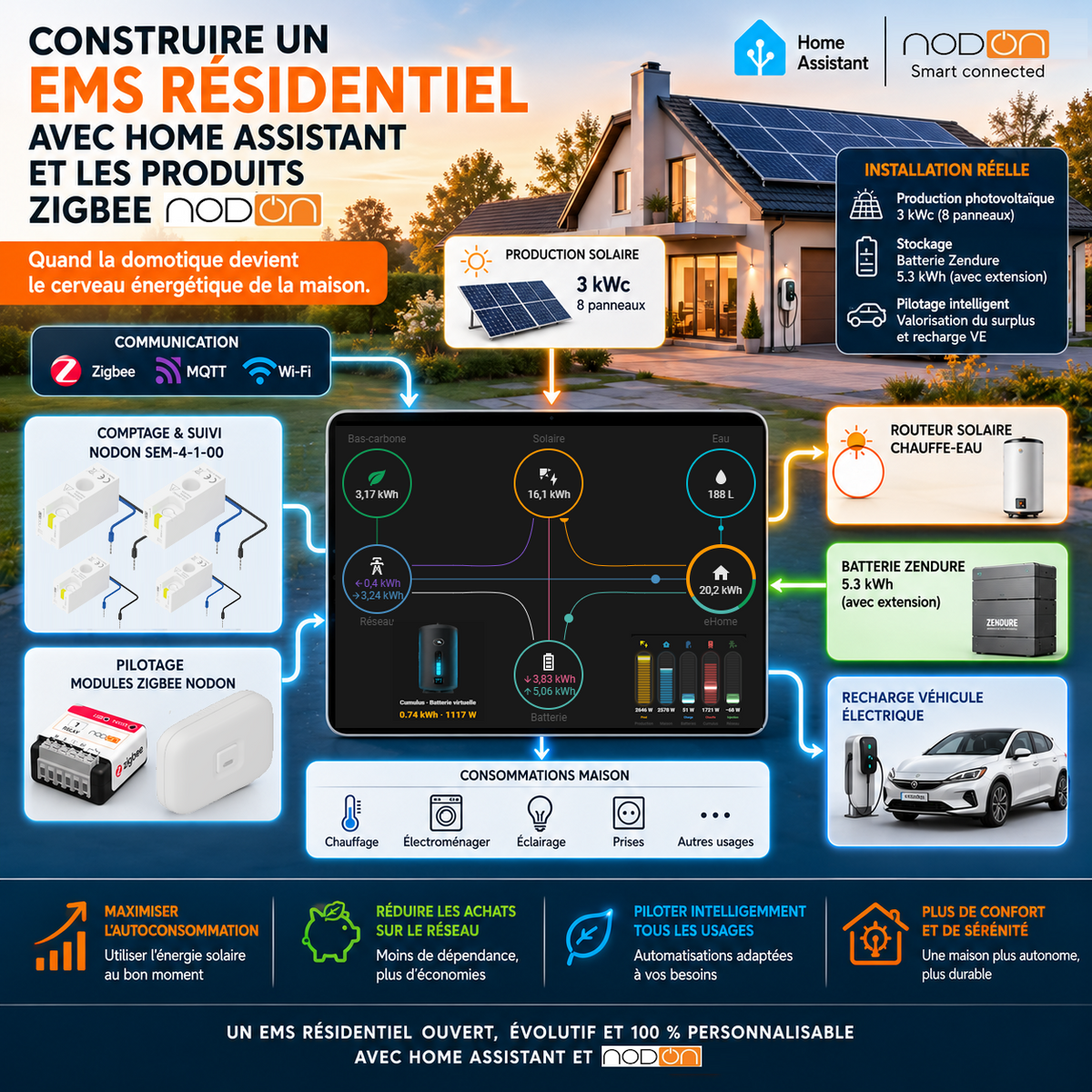
All demonstrations presented in this series are based on a real installation, used daily and fully controlled by Home Assistant. This installation relies on the elements listed below:
| Element | Configuration |
|---|---|
| ☀️ Photovoltaic production | 3 kWp |
| 🏠 Home automation system | Home Assistant |
| 📡 Protocols | Zigbee, MQTT, Wi-Fi |
| ⚡ Energy measurement | NodOn SEM-4-1-00 energy meters |
| 🔌 Control | NodOn Zigbee modules |
| 🔋 Battery | Zendure with extension – 5.3 kWh |
| 🚿 Surplus valorization | Solar router for water heater |
| 🚗 EV charging | Smart control via Home Assistant |
The aim of this series is thus to show, based on this concrete installation, how to automate and optimize energy production, storage, and consumption on a daily basis.
Building a Residential EMS with Home Assistant and NodOn Zigbee products
When home automation becomes the energy brain of the house.
Article 1/4 of the series "Residential EMS by Pascal Stephany"
The energy transition is no longer just about producing one's own electricity. Today, the real challenge is to use this energy at the right time, in the right place, and for the right purpose.
This is precisely the role of an EMS (Energy Management System): to supervise all energy flows to optimize self-consumption, limit grid consumption, and improve occupant comfort.
Thanks to Home Assistant and NodOn Zigbee solutions, it is now possible to build a powerful, scalable, and completely open residential EMS.
What is a residential EMS?
An EMS is a system capable of collecting data from various devices, analyzing them, and then automatically making decisions.
Unlike simple energy monitoring, an EMS acts in real-time. It can answer questions such as:
- Should I heat the hot water tank now?
- Is it better to charge the battery?
- Can I start charging the electric vehicle?
- Should I prioritize thermal comfort or energy storage?
- Will I need to import electricity in a few minutes?
All these decisions are based on reliable data and intelligent automations.
An open architecture
One of the main advantages of Home Assistant is its openness. Unlike proprietary solutions limited to a single manufacturer, it allows devices from different brands to communicate within the same system.
In my installation, the EMS relies on:
- NodOn Zigbee energy meters SEM-4-1-00;
- SIN-4-1-21 control modules;
- IRB-4-1-00 infrared controller;
- home batteries;
- photovoltaic micro-inverters;
- the solar router;
- the electric vehicle charging station.
Home Assistant thus becomes the true orchestrator of the installation.
Measure before deciding
An effective EMS always begins with precise measurement.
The SEM-4-1-00 allows real-time tracking of:
- household consumption;
- photovoltaic production;
- grid import;
- grid injection;
- main electrical circuits.
This information constitutes the "eyes" of the system. Without it, no relevant decision can be made.

Intelligently control usage
Once the data is available, Home Assistant can act.
Thanks to the SIN-4-1-21 modules, several devices become controllable:
- water heater;
- electric heating;
- certain specific circuits;
- programmable equipment.
Each decision is made according to the actual needs of the house, not according to a simple timed schedule.
Integrate comfort into the energy strategy
Energy is not only used to power equipment. It also contributes to the comfort of occupants.
The IRB-4-1-00 controller, for example, allows the integration of an infrared-compatible air conditioning unit or heat pump into Home Assistant.
The EMS can then decide to start cooling when there is sufficient photovoltaic surplus, or automatically adjust the temperature according to weather conditions and energy availability.
Comfort thus becomes a variable in the energy equation.
Batteries are not always a priority
One common misconception is to want to charge a battery as soon as photovoltaic surplus is available.
In reality, an EMS primarily seeks to optimize overall energy use.
Depending on the situation, it may be more relevant to:
- produce domestic hot water;
- directly power household appliances;
- charge an electric vehicle;
- or only then store energy in a battery.
This prioritization helps improve the overall efficiency of the installation.
Visualize to understand
One of Home Assistant's major strengths lies in the quality of its dashboards.
The data reported by NodOn products allows for a clear representation of energy flows:
- photovoltaic production;
- household consumption;
- batteries;
- controlled equipment;
- grid import and injection.
At a glance, the user immediately understands what is happening in their home.

An installation that evolves with needs
Unlike a closed solution, an EMS built around Home Assistant evolves over time.
It is possible to gradually add:
- new energy meters;
- control modules;
- temperature sensors;
- batteries;
- a charging station;
- new automation scenarios.
The installation grows with the needs of the occupants, without questioning existing equipment.
My experience
After several years of evolution, my installation has gone from simple energy monitoring to a true residential EMS.
Today, Home Assistant makes dozens of decisions every day based on information provided by NodOn Zigbee products.
Energy meters measure flows, modules control equipment, batteries store energy when relevant, and dashboards offer a clear overview of the whole.
The result is not just a reduction in grid consumption.
It is above all a home capable of automatically adapting to production conditions, lifestyle habits, and occupant needs.
Key takeaways
✔ An EMS optimizes energy flows in real time.
✔ NodOn meters provide essential data for decision-making.
✔ Zigbee modules allow for automatic control of equipment.
✔ Home Assistant centralizes, analyzes, and orchestrates all scenarios.
✔ An open architecture guarantees a scalable installation independent of proprietary ecosystems.
Products used
- SEM-4-1-00 – Zigbee Smart Energy Meter
- SIN-4-1-21 – Zigbee Multifunction Module with Consumption Measurement
- IRB-4-1-00 – Zigbee AC Infrared Controller
 eHome Labs
Passionate about home automation for over 20 years, I evolve my installation in step with my experiments and new technologies. Each automation is tested in real conditions before being adopted daily, making this installation a true life-size laboratory.
This approach allows me to continuously refine the home's energy strategy and fully exploit the possibilities offered by Home Assistant and NodOn Zigbee solutions.


Leave a comment
This site is protected by hCaptcha and the hCaptcha Privacy Policy and Terms of Service apply.